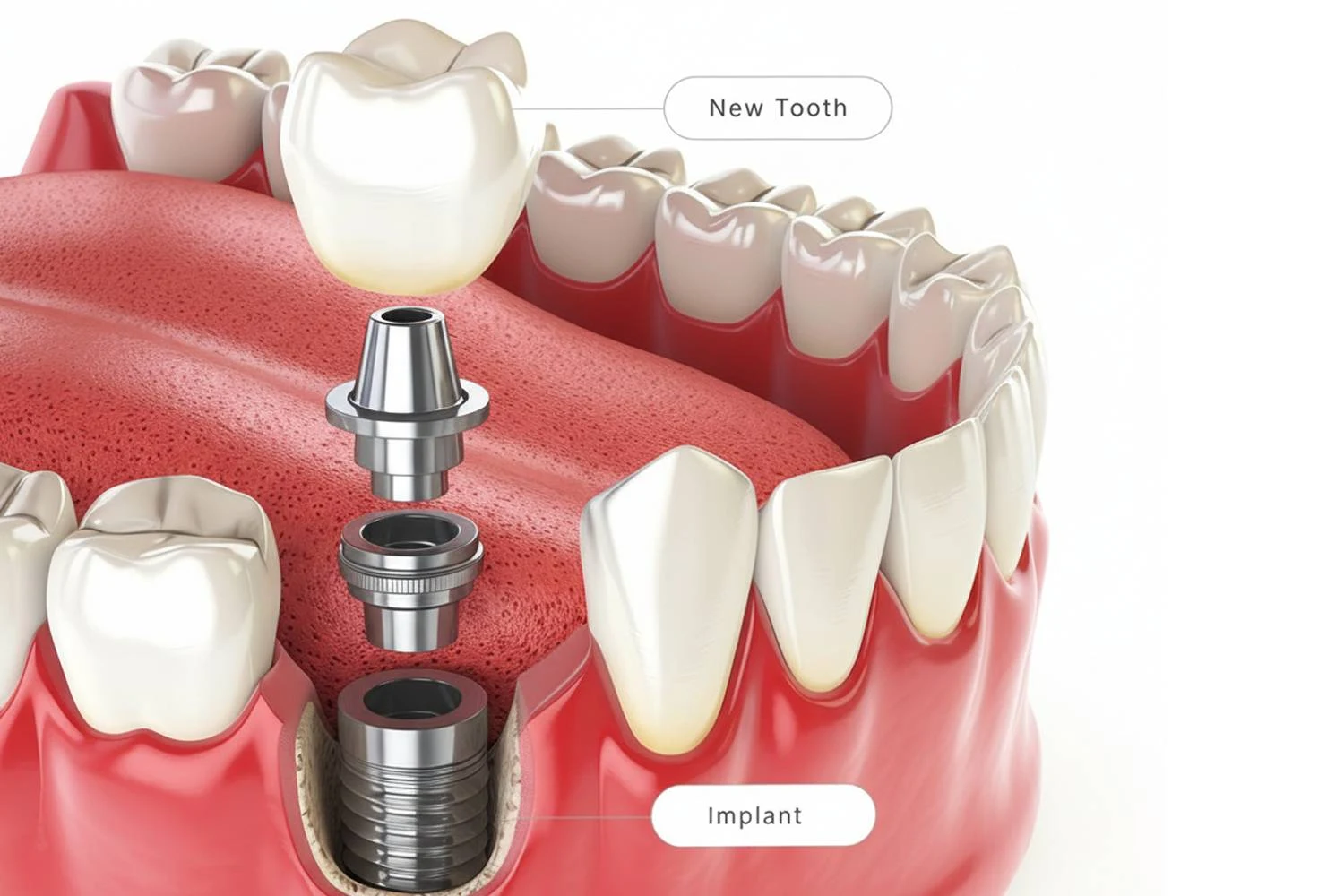
A dental implant is designed to replace the entire structure of a missing tooth, not just the part you can see. Unlike a bridge or denture, an implant is placed directly into the jawbone to act as an artificial tooth root. Once healed, it supports a custom-made crown that is designed to look, feel, and function like a natural tooth.
One of the biggest advantages of dental implants is that they help preserve the jawbone. After a tooth is lost, the surrounding bone no longer receives the stimulation it needs during chewing, causing it to gradually shrink over time. Because an implant replaces the tooth root, it continues to stimulate the bone, helping to maintain both the health of your jaw and the natural shape of your smile.
Whether you’re missing one tooth, several teeth, or all of your teeth, dental implants can be used in a variety of treatment options. During your consultation, your dentist will assess your oral health and discuss the most suitable approach for your individual needs.
Your Dental Implant Journey: Step by Step
Every smile is different, but most dental implant treatments follow the same general process.
Your journey begins with a comprehensive consultation, where your dentist will examine your teeth and gums, review your medical history, and take 3D imaging to assess the quality and quantity of your jawbone. This information allows us to determine whether you’re suitable for dental implants and create a personalised treatment plan.
The implant is then placed into the jawbone under local anaesthetic, with sedation available for patients who feel anxious. Over the following three to six months, the implant naturally fuses with the surrounding bone in a process called osseointegration, creating a stable foundation for your new tooth. During this healing period, a temporary tooth can often be provided so you don’t have to live with a noticeable gap.
Once healing is complete, digital impressions are taken, and your custom-made crown is fitted, carefully matched to the shape, size, and colour of your surrounding teeth for a natural-looking result.
Depending on your individual needs, treatment may involve replacing a single tooth, several missing teeth, or a full arch of teeth. In some cases, it may even be possible to place an implant on the same day a tooth is removed. Your dentist will recommend the most appropriate approach based on your oral health and treatment goals.
Why Timing Can Make a Difference
If you’ve recently lost a tooth, it’s worth arranging a consultation sooner rather than later. After a tooth is removed, the surrounding jawbone naturally begins to shrink because it no longer receives the stimulation that comes from supporting a tooth root.
The amount of bone available plays an important role in implant treatment. When there is plenty of healthy bone, treatment is often more straightforward. If significant bone has already been lost, procedures such as bone grafting may be recommended to rebuild the area before an implant can be placed.
The good news is that it’s rarely too late for dental implants. Even if you’ve been missing a tooth for months or years, many patients are still suitable candidates with the right treatment plan. The best way to understand your options is through a comprehensive assessment with an experienced implant dentist.
Recovery and Healing after Dental Implant Treatment
One of the most common questions patients have about dental implants is what to expect after the procedure. While every patient’s experience is different, most people are surprised by how manageable the recovery process can be.
Immediately after implant placement, it is normal to experience some mild swelling, tenderness, or sensitivity around the treatment area. These symptoms typically improve over the first few days and can usually be managed with simple measures recommended by your dentist.
During the healing phase, the dental implant gradually bonds with the surrounding jawbone through a process called osseointegration. This is an important stage of treatment because it creates the strong foundation needed to support your final crown or dental restoration.
Healing times vary depending on factors such as the number of implants placed, the location of the implant, bone quality, and whether additional procedures such as bone grafting were required. For many patients, the implant is allowed to heal for approximately three to six months before the final crown is attached.
Looking after your implant during this time is important. Maintaining good oral hygiene, attending follow-up appointments, and following your dentist’s instructions will help support successful healing and long-term results.
Once healing is complete, your custom-made crown is fitted and carefully adjusted to ensure it feels comfortable, functions naturally, and blends seamlessly with your smile.
Caring for Your Dental Implants in the Long Term
Dental implants are designed to be a long-term solution for replacing missing teeth. With good oral hygiene, regular dental check-ups, and ongoing professional maintenance, many implants can last for decades.
While the titanium implant itself is exceptionally durable, the long-term success of treatment also depends on maintaining healthy gums and supporting bone. Factors such as smoking, uncontrolled gum disease, and poor oral hygiene can all affect the lifespan of an implant. Like natural teeth, the crown attached to the implant may eventually need replacing due to normal wear, but the implant beneath can often remain stable for many years.
By caring for your implant in the same way you care for your natural teeth, you can give it the best chance of providing a lifetime of comfortable, reliable function.
Are Dental Implants Right for You?
Dental implants are an excellent option for many people, but the right treatment always depends on your individual circumstances.
You may be a suitable candidate if you:
- Are missing one or more teeth.
- Want a fixed, natural-looking alternative to dentures.
- Would like to replace missing teeth without altering healthy neighbouring teeth.
- Have healthy gums and sufficient jawbone, or are suitable for procedures such as bone grafting if additional support is needed.
Even if you’ve been missing a tooth for many years, you may still be a candidate for dental implants. The best way to determine your suitability is through a comprehensive consultation, where your dentist can assess your oral health, discuss your goals, and explain all available treatment options.
We understand that cost is an important consideration, which is why we offer flexible payment options to help make treatment more accessible.
Restore Your Smile with Confidence
Dental implants are one of the most predictable and effective ways to replace missing teeth, restoring both the appearance and function of your smile. Every patient is different, however, and successful treatment begins with a thorough assessment and a personalised treatment plan.
At Taylors Lakes Dental House, we take the time to understand your needs, answer your questions and guide you through every stage of treatment. Whether you’re missing a single tooth or require a more complex solution, we’re here to help you make an informed decision with confidence.
If you’d like to find out whether dental implants are right for you, contact our team to arrange a consultation.
Frequently Asked Questions
What are dental implants made of?
The implant itself is most commonly made from titanium, a strong and biocompatible material that is well tolerated by the body. Over time, the jawbone naturally bonds with the titanium surface through a process called osseointegration, creating a stable foundation for the replacement tooth.
The visible part of the tooth replacement is the crown, which is usually made from durable materials such as porcelain or ceramic and is carefully designed to match your natural teeth.
How long do dental implants last?
With proper care and regular dental maintenance, dental implants can provide a long-lasting solution for replacing missing teeth. The implant itself is designed to remain stable for many years, while the crown may eventually require replacement due to normal wear.
The long-term success of an implant depends on several factors, including your oral hygiene, gum health, lifestyle factors such as smoking, and attending regular dental check-ups.
What are the parts of a dental implant?
A dental implant is made up of three main components that work together:
- The implant: A small titanium post placed into the jawbone to replace the missing tooth root.
- The abutment: A connector that attaches the implant to the final restoration.
- The crown: The custom-made tooth that sits above the gum and restores the appearance and function of your natural tooth.
Can I have an implant placed immediately after a tooth extraction?
In some cases, yes. This is known as immediate implant placement, where the implant is inserted at the same appointment as the tooth extraction.
However, this approach is not suitable for everyone. Your dentist will assess factors such as the quality of your bone, the health of your gums, and whether there is any infection present before recommending this option.
Do I need an implant for every missing tooth?
Not always. The number of implants required depends on your individual situation, including the location of the missing teeth, your bite, and the condition of your surrounding teeth and bone.
For example, when several adjacent teeth are missing, multiple implants can sometimes be used to support a dental bridge rather than placing one implant for every missing tooth. Your dentist will recommend the approach that provides the best balance of function, aesthetics, and long-term stability.